Prithvi Highway blockage ends Thursday as Krishnabhir link restored
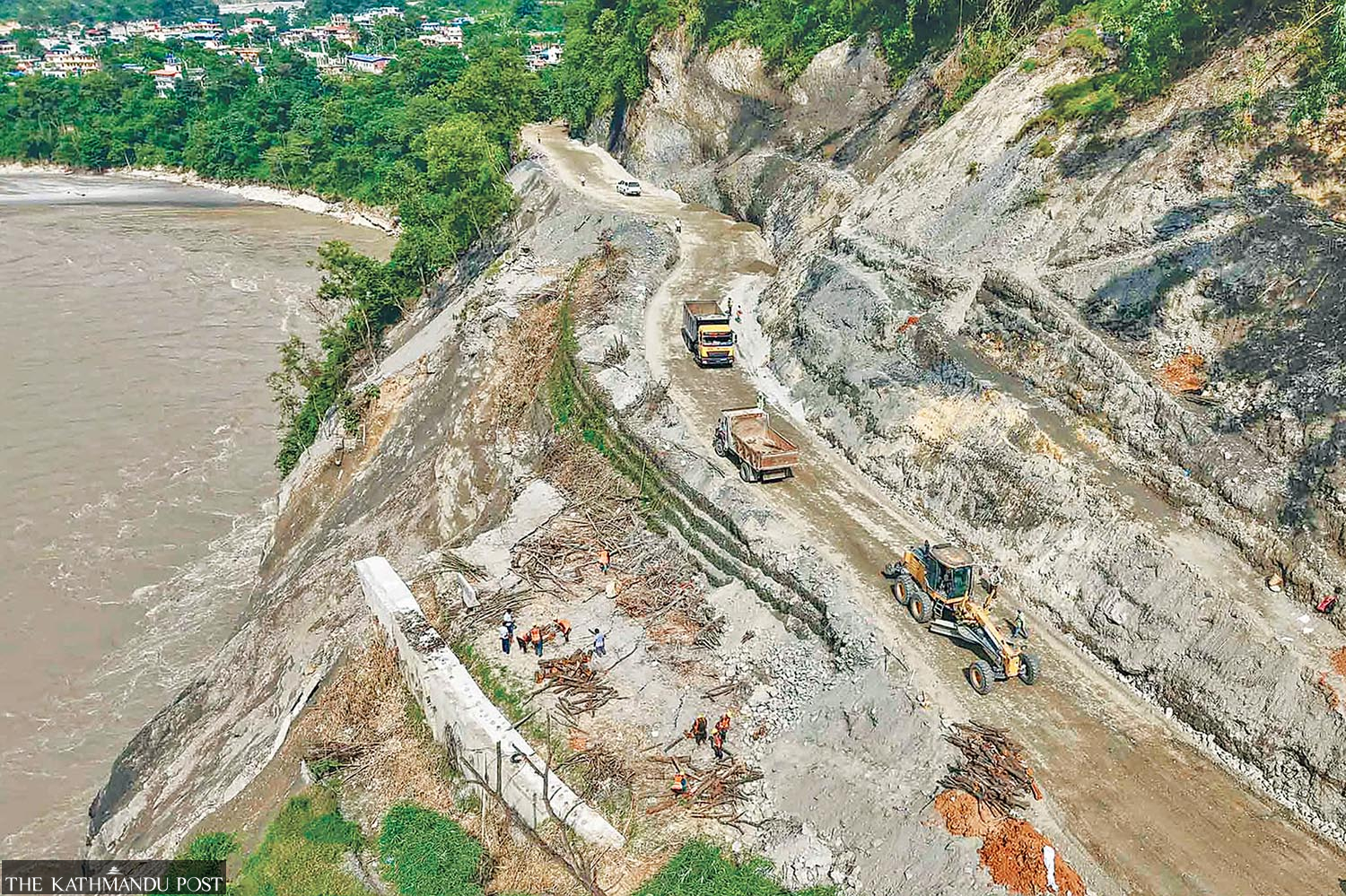
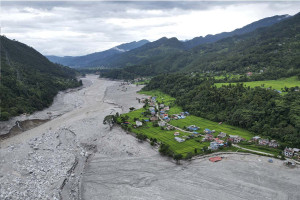
A new track above the damaged section will restore two-way traffic while authorities continue work to stabilise the route.Rollers level the track opened to bypass a collapsed section of Prithvi Highway in Dhading. Nepal Photo Library
Two-way traffic will resume on the Krishnabhir section of Prithvi Highway from Thursday morning, 18 days after a landslide triggered by the Rasuwa flood cut off the key road linking Kathmandu with western Nepal.
Authorities have opened and gravelled a new 270-metre track above the section where the original road was destroyed. Vehicles will be allowed to use both lanes from 6am on Thursday, according to the Malekhu-Mugling Road Project.
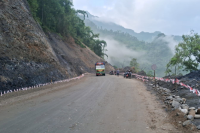
The reopening will restore the highway as a direct route, although several sections between Nagdhunga and Mugling remain narrowed to one lane because of flood damage and landslides.
Sajana Adhikari, chief of the Malekhu-Mugling Road Project, said gravel-laying on the new section was completed on Wednesday evening. Gas tankers and trucks that had been trapped by the landslide had already been using the track on a trial basis since Sunday. All types of vehicles will be allowed from Thursday.
Road lights are also being installed at Krishnabhir to make night-time travel safer, Adhikari said. Drainage work and measures to strengthen the new road are also underway.
The gravel track is being treated as a temporary solution. The Department of Roads plans to monitor its performance for about two weeks before deciding when to blacktop it. The trial period will allow engineers to assess its load-bearing capacity and stability, while improved weather conditions should make blacktopping easier.
The reopening of Krishnabhir will not immediately restore smooth travel between Nagdhunga and Mugling. Several sections of the highway remain restricted to one lane because of erosion and landslides.
On the Mugling-Malekhu section, Shital Bazar and Jawang Khola remain narrowed after landslides and river erosion damaged the road. Further towards Kathmandu, the highway has been reduced to one lane at several points, including below the Nagdhunga checkpoint, Galchhi, Mahesh Khola, Baireni and Malekhu.
Bijaya Jaishi, director general of the Department of Roads, said work was underway to restore two-way traffic at the remaining damaged sections.
While Krishnabhir was blocked, traffic between Kathmandu and western Nepal was being diverted through Hetauda and roads connecting Gorkha. The Nagdhunga-Sisnekhola tunnel will continue operating, according to the department.
About 50 workers, including technical staff, worked 12 to 16 hours daily to build the new track. Post Photo
Alternative route being upgraded
The government is also continuing work on an alternative route intended to provide a more reliable bypass around Krishnabhir.
The preferred alternative would run from Benighat, cross the Trishuli river and rejoin the Prithvi Highway at Fisling in Chitwan. The government had already decided to upgrade the route.
“We believe the road from Benighat across the Trishuli river to Fisling is the most suitable alternative to Krishnabhir,” Jaishi said. “We will upgrade it and eventually blacktop it.”
About 1.5 kilometres of track remains to be opened along the roughly 18-kilometre route. The Department of Roads aims to complete the track opening and upgrading work within four months.
Engineers are also studying longer-term options, including a tunnel beneath Krishnabhir or a bypass bridge. The Ministry of Infrastructure Development and the Department of Roads have separately commissioned experts to assess whether a tunnel through the hillside or a bridge bypassing the unstable section would be more suitable.
Jaishi said the government is expected to decide within six months after receiving the experts’ recommendations.
“Krishnabhir has always been a difficult landslide zone. This time, the Trishuli river eroded a large section of the road, the retaining wall collapsed, and the slope beneath the road was washed away,” Jaishi said.
“The new track is based on experts’ advice, but it is not a long-term solution. We will continue work on the Fisling-Benighat alternative as well.”
Engineers are also considering whether the existing Krishnabhir stretch can be restored during the dry season. Once the Trishuli river’s water level falls, one option would be to build a reinforced concrete retaining wall from the foundation to relink the straight road.
Such work would require the river flow to be diverted from the section and a detailed geotechnical assessment of the slope, ministry officials said.
Krishnabhir’s unstable slopes have left the stretch vulnerable to landslides and road closures.
The section, in Benighat Rorang Rural Municipality of Dhading, first suffered a major landslide in 1999. A larger landslide the following year blocked the highway for 11 days.
Authorities carried out slope-stabilisation work in 2007 using bioengineering and retaining walls after identifying landslide risks both above and below the road.
The slope again began shifting and sinking last October because of water infiltration, according to the Department of Roads.
The department had already been trying to protect the highway from erosion by installing micropiles and horizontal anchors below its surface. It had also begun concreting sections to prevent water from penetrating the road structure.
Prime Minister Balendra Shah told the House of Representatives on September 2 that the government was working to reopen the road by mid-September. Following consultations with experts, the ministry decided to widen and extend the new track above the damaged section as an immediate solution.
About 50 workers, including technical staff, worked 12 to 16 hours a day to build the new road.
The government has also begun repairing suspension bridges damaged by floods along the Trishuli-Mugling corridor.
Floods swept away several bridges, including a bridge connecting Bidur and Trishuli Bazar in Nuwakot and a road bridge connecting Malekhu-Phurke Khola with Dhadingbesi.
Repair work has begun on 12 suspension bridges along the Trishuli corridor. These include bridges at Kalikasthan, Malinga-Majhuwatar Dobhan, Mahadewa Mastar, Chiraundi Khola, Shital Bazar and Belkhu Bhutiya in Dhading.
The government is also repairing the Keureni-Gahate, Pimaltar-Jagaram, Kolputar-Kalleri, Phosretar and Philing suspension bridges linking Nuwakot and Dhading, as well as the Badare suspension bridge connecting Gorkha and Dhading.
The government aims to reopen the bridges by October 6.
Another 33 suspension bridges on the corridor were damaged beyond repair and will have to be rebuilt. The Office of the Prime Minister and Council of Ministers said tenders had been invited for their reconstruction.




 25.12°C Kathmandu