Nepal’s wetlands are under pressure. Migratory birds are losing safe havens
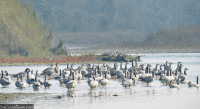
Falling bird numbers and species diversity across major wetlands point to the growing risks for a migration corridor that links Nepal to breeding and wintering grounds across Asia.Bar-headed geese that come to Nepal to winter, pictured in Chitwan in 2023. These waterbirds spend their summers in Central Asia. Ramesh Kumar Paudel/TKP
Birds know no national borders. Travelling thousands of kilometres, they move across continents in search of breeding grounds, food, and warmth. If a single wetland along their arduous route dries up, becomes polluted, or falls victim to human encroachment, the consequences ripple far beyond that immediate site, impacting avian populations across another continent entirely.
Whether it is ducks gliding gracefully over water surfaces or shorebirds foraging along muddy banks, the vibrant chatter and presence of birds keep wetland ecosystems alive. Yet in recent years, these familiar sights have been quietly slipping away. Flocks that once numbered in the hundreds are dwindling at an alarming rate, and in several wetlands and lakes across Nepal, species diversity is noticeably shrinking.
Data from recent waterbird counts conducted in Nepal’s major wetlands underscores this grim reality. In 2025, surveyors recorded 96,565 aquatic birds across major sites in the country. By 2026, that number dropped to 90,688. The total number of recorded species also dwindled from 94 to 89 within the same timeframe.
The ecological shift unfolding in Nepal’s wetlands is a localised reflection of a staggering global crisis. According to the newly released State of the World’s Birds report, out of 1,843 migratory bird species evaluated worldwide, 45 percent are experiencing active population declines. Roughly one in nine—or 11 percent—of all migratory bird species are now threatened with global extinction.
Conservationists argue that the conversation must now urgently shift from merely despairing over the plight of migratory birds to examining how safe their designated sanctuaries and wetlands truly are.
Ishana Thapa, Chief Executive Officer of Bird Conservation Nepal (BCN), emphasised that safeguarding migratory birds cannot be achieved by any single nation acting in isolation.
“If a bird migrates to Nepal for the winter, protecting it while it is here is simply not enough,” said Thapa, who attended the recent Global Flyways Summit in Nairobi, Kenya. “The breeding grounds, stopover sites, and other wintering habitats that the bird relies on during the rest of the year must also be secured.”
The landmark report, presented during the summit held from September 8 to 11, paints an alarming picture of the worsening state of migratory birds worldwide.
45 percent of species declining globally
According to the report, 45 percent of the 1,843 migratory bird species surveyed globally are in decline. Meanwhile, 30 percent of species maintain stable populations, 14 percent are increasing, and the status of the remaining 11 percent remains unknown due to insufficient data.
The assessment identified 200 migratory bird species—representing 11 percent of the total—as threatened with global extinction. Among these, 32 species are critically endangered, 57 are endangered, and 111 are categorised as vulnerable. An additional 111 species have been placed in the “near threatened” category, meaning that approximately 17 percent of the world’s migratory birds are now of significant conservation concern.
The crisis is particularly acute among specific groups. Roughly 54 percent of migratory shorebird species and 49 percent of migratory seabird species are suffering population drops. Furthermore, between 47 and 51 percent of species tied to marine habitats, forests, and coastal wetlands are experiencing steady declines.
Among the four major land-based flyway systems, the East Asian-Australasian Flyway shows the highest proportion of declining species, at 53 percent. Half of the migratory bird species that utilise the world’s six marine flyways are also dwindling. Long-distance migrants traveling between Europe and Africa have seen their numbers plummet by approximately 35 percent since 1980. Quoting historical monitoring data, the report noted that in North America alone, an estimated 2.5 billion migratory birds across 419 species were lost between 1970 and 2017.
Migratory species dependent on intertidal wetlands and coastal habitats have been hit the hardest. In North America, out of 28 shorebird species monitored between 1980 and 2019, 26 showed persistent population drops, with more than half losing over 50 percent of their population. The report further noted that at least seven migratory bird species are believed to have gone completely extinct worldwide over the last 150 years.
The risk of extinction continues to escalate. A total of 102 species moved into higher risk categories due to genuine deterioration in their conservation status, while only 34 species managed to move to lower risk categories thanks to successful conservation interventions.
Human activities remain the primary cause behind these mounting threats. Severe pollution, increasing hunting, habitat fragmentation, and global temperature rises top the list of hazards.
Invasive alien species and disease currently impact 139 threatened migratory bird species, while agricultural expansion and climate change adversely affect 103 species each.
Illegal hunting and trapping threaten 99 vulnerable species, followed by pollution (96 species), urban development (71), general human disturbance (65), commercial fishing (62), energy infrastructure (55), and deforestation (39).
Illegal killing and trapping pose an ongoing menace. In Europe, the Mediterranean, the Caucasus, and the Arabian Peninsula alone, an estimated 13.1 million to 42.7 million migratory birds are illegally killed or taken from the wild every year. A vast majority of these are songbirds, captured using nets, snares, or lime sticks. On remote islands where seabirds breed, accidentally introduced invasive predators such as rodents continue to devastate nesting colonies.
The destruction and degradation of natural habitats represent another major threat. Scientific monitoring over the past decade reveals that more than half (58 percent) of the 1,099 key biodiversity areas identified as critical for migratory birds are in poor or very poor ecological condition.
In response, the report issues an urgent call for strengthened international cooperation to protect and restore critical habitats, curb illegal hunting, minimise seabird mortality from fishing gear, control invasive species, and make agriculture, forestry, and infrastructure development wildlife-friendly. Progress towards the biodiversity conservation targets adopted by 196 countries for 2030 remains dangerously slow, the document warned.
What pressure does the report place on Nepal?
Past waterbird monitoring and studies in Nepal have consistently pointed to habitat destruction, pollution, illegal hunting, human encroachment, and land-use changes as the primary threats.
Thapa noted that the global report places four key pressures on Nepal—making wetland conservation far more effective, managing entire flyway networks rather than isolated sites in isolation, integrating bird conservation into national infrastructure planning, and strengthening data sharing and long-term monitoring.
“We must focus on whether the ecological integrity of our important wetlands is being maintained, whether regular monitoring is taking place, and whether habitat degradation is being halted,” said Thapa. “Wetlands cannot be viewed as standalone locations; they must be managed as interconnected components of the broader Central Asian Flyway network.”
According to her, when decisions are made regarding the location and design of development projects—such as roads, power transmission lines, hydropower plants, irrigation schemes, urbanisation, and renewable energy infrastructure—migratory routes and critical bird habitats must be formally integrated into environmental impact assessments.
Hum Bahadur Gurung, senior Asia partnership manager at BirdLife International Asia, who also attended the Nairobi summit, emphasised the paramount importance of secure stopover sites for migratory species.
“Migratory birds do not recognise political boundaries… but during journeys spanning thousands of kilometres, they require safe places to land, feed, and rest,” said Gurung. “Ensuring the safety of these stopover sites requires robust regional cooperation among all countries along the route.”
Why are flyways crucial?
Flyways are the established geographic corridors used by bird species as they travel between their breeding grounds and non-breeding wintering areas. Globally, four main land-based flyway systems serve terrestrial and aquatic birds—the Americas Flyway, the African-Eurasian Flyway, the Central Asian Flyway, and the East Asian-Australasian Flyway.
Nepal lies within the Central Asian Flyway, which extends from Central Asia through South Asia to the Indian subcontinent. Nepal acts as a vital sanctuary along this route. Every winter, birds fleeing the freezing breeding grounds in the northern hemisphere rely on Nepal’s wetlands for shelter, food, and habitat for winter.
As they travel south, these winter visitors settle across diverse landscapes ranging from the Himalayan foothills and mid-hill valleys to the plains, lakes, and marshes of the Tarai. The majority of winter migrants are waterbirds, arriving from cold regions including Mongolia, Kyrgyzstan, Koreas, Tibet, eastern Europe, and northern India. Some species undertake staggering journeys, flying nearly 5,000 kilometres from Siberia to reach Nepal. Of the roughly 150 bird species that migrate to Nepal in winter, the vast majority are waterbirds.
If a single key wetland, forest, or coastal staging ground along this corridor is destroyed, the loss can jeopardise the entire global population of that migrating species.
Hathan Chaudhary, president of the Nepalese Ornithological Union, said migratory birds depend heavily on water bodies and agricultural fields, which must therefore be rigorously protected.
“Ducks gather in lakes and reservoirs, while Demoiselle cranes rely on open farmland. However, the excessive use of chemical pesticides in modern agriculture is causing a noticeable decline in their numbers,” said Chaudhary.
As nations across Asia push for rapid economic development, the environmental toll on wildlife continues to mount, said Gurung. “Asia is developing rapidly, and its massive energy requirements mean that birds face a growing risk of power line collisions. In wealthier nations, massive wind turbines present an additional hazard along flight paths,” said Gurung.
“If Nepal and Bhutan execute excellent conservation work but neighboring India does not, the migration corridor is effectively broken. Successful conservation is only achievable through seamless regional communication, data exchange, and cross-border collaboration,” he said.
How safe are Nepal’s wetlands?
Nepal’s wetlands serve as indispensable resting, feeding, and energy replenish hubs for migratory birds. Renowned sites such as Koshi Tappu Wildlife Reserve, Bishajari and surrounding lakes, and the wetland buffer zones of Chitwan National Park provide vital refuges for storks, herons, egrets, and cranes.
Similarly, Ghodaghodi lake in Kailali, Jagadishpur reservoir in Kapilvastu, Barju lake in Sunsari, the wetlands of Shuklaphanta and Bardiya national parks, Pokhara lakes, and in Kathmandu, the Taudaha lake and the Manohara riverbanks remain prime destinations for wintering birds.
Yet, human encroachment, pesticide contamination, and the conversion of wetlands into agricultural or commercial land are steadily shrinking these natural sanctuaries. A lack of dedicated management has caused several wetlands to dry up, and reduced water availability directly impacts bird survival.
Unplanned electricity infrastructure poses another severe collision hazard. The construction of concrete structures, hotels, and restaurants around lake perimeters directly degrades avian habitats, while noise pollution and unmanaged waste continue to drive birds away, experts say.
Chaudhary described the situation in Koshi Tappu—historically celebrated as the bird capital of Nepal—as increasingly dire. “The natural oxbow lakes and marshes here have largely dried up following historic shifts and flooding of the Koshi river,” said Chaudhary. “Where we once saw massive flocks of around 50,000 ducks, seeing even a hundred ducks today feels like a rare event.”
The aggressive spread of invasive water hyacinth in open water bodies has compounded the crisis. “In Badhaiya lake of Bardiya, invasive weeds have covered almost the entire water surface. Despite repeated cleanup efforts at Barju lake, the weed returns, preventing birds from foraging,” said Chaudhary. “Furthermore, loud picnic parties with blaring loudspeakers near wetlands disrupt the natural quiet birds require.”
In the 2026 waterbird census, half of the surveyed monitoring sites across Nepal recorded noticeable declines in species diversity compared to the previous year. Species counts dropped across Koshi Tappu Wildlife Reserve, Barju Lake, Jagadishpur reservoir, Banke National Park, Ghodaghodi lake, Nakhodi lake, Rara lake, Pokhara Valley lakes, Taudaha, and the Bagmati river corridor. While species diversity slightly rose in Chitwan and Bardiya, total bird numbers still declined.
On a positive note, both species counts and individual bird numbers showed modest gains in Dhanusha, the Kamala river, Hetauda wetlands, the Lumbini area, the Babai and Rapti rivers, Shuklaphanta, Puraini (Banke), Bannadha lake, and the Manohara floodplains.
BirdLife International recognises Koshi Tappu and Chitwan National Park as among the 32 priority sites along the Central Asian Flyway. Thapa noted that key wetlands such as Koshi Tappu, Jagadishpur reservoir, and the major river systems of Chitwan serve as crucial transit hubs for high-altitude migrants crossing the Himalayas.
Although Nepal has instituted protective legal frameworks through Ramsar site designations, protected areas, and bird sanctuaries, human pressure remains intense across most wetlands.
“Protecting the surface area of a wetland alone is not sufficient. A wetland’s true ecological viability depends on water quality, natural hydrological flow, food availability, freedom from human disturbance, control of invasive species, prevention of illegal poaching, and sustainable land-use practices in surrounding areas,” said Thapa.
Flyway conservation investment plans
Under the Nairobi Flyways Declaration, three major international development banks have pledged to formally incorporate flyway conservation into their lending frameworks. These financial institutions have committed to mobilising up to $6 billion to protect and restore critical migratory habitats along global corridors.
At the summit, the Asian Development Bank (ADB) unveiled an ambitious plan to deploy $3 billion over the next decade to safeguard at least 50 priority wetland ecosystems within the East Asian-Australasian Flyway. This investment aims to directly benefit these vital ecosystems as well as an estimated 200 million people whose livelihoods depend on them.
Similarly, the Development Bank of Latin America and the Caribbean announced plans to mobilise $3 billion to $5 billion by 2050 to conserve more than 30 critical landscapes and seascapes. Meanwhile, the World Bank and BirdLife International reaffirmed their commitments to direct billions of dollars towards securing flyways used by over two billion migratory birds across Africa, Europe, and Asia.
In June 2026, the Global Environment Facility approved the establishment of the Global Flyways Grant Mechanism. The facility includes $89.7 million in direct grant funding alongside $107 million in co-financing. This initiative aims to restore and protect 9 million hectares of degraded wetlands and directly benefit an estimated 330,000 local community members.
Since 2021, multilateral development banks have successfully mobilised over $6 billion in conservation-focused financing. BirdLife International highlighted these commitments as a monumental shift towards globally coordinated flyway conservation.
Birds fly thousands of exhausting kilometres to reach Nepal every year. Yet their journey does not end in these valleys and plains; the return leg across mountain ranges and deserts is equally grueling. If a single stopover wetland disappears from their path, it disrupts far more than an individual flight—it threatens an ancient migratory cycle refined over countless generations.
“Of the globally threatened bird species, 40 are found in Nepal, and their populations here have remained relatively stable so far,” said Chaudhary. “However, we cannot afford to be complacent. As conservationists, our role is to identify the problems and point out the threats. The responsibility for executing solutions lies squarely with the government. The Department of National Parks and Wildlife Conservation, the Ministry of Forests and Environment, and non-governmental organisations must build far tighter coordination to safeguard these vulnerable species.”
A destroyed habitat in one country can disrupt migration paths thousands of kilometres away. Protecting migratory birds is therefore a mission that no single country or isolated wetland can accomplish alone. Only sustained cross-border collaboration and dedicated protection along the entire length of the flyway can ensure that these remarkable journeys remain safe for generations to come.




 25.12°C Kathmandu