Government’s 30,000 MW power goal at risk as PPA bottlenecks stall hydropower push
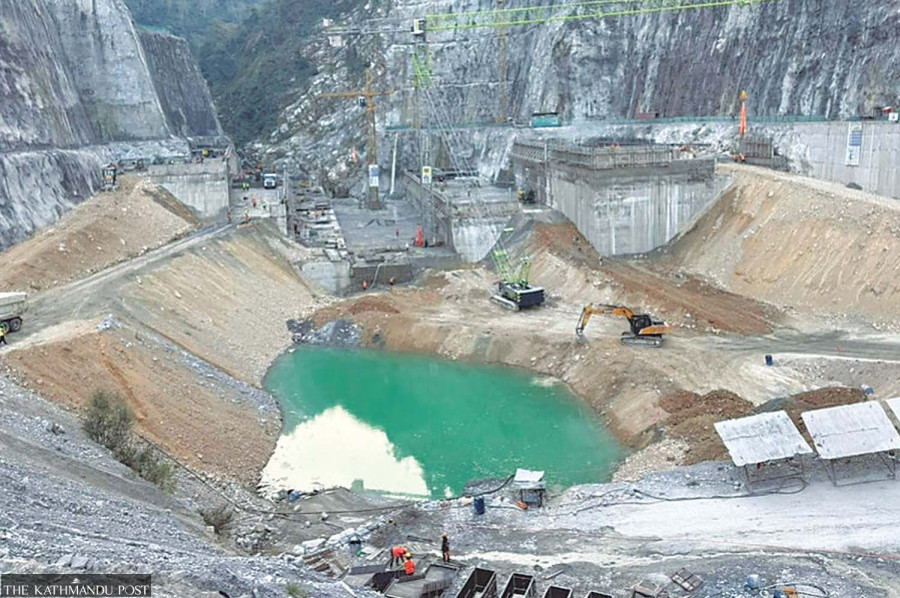
Stakeholders say the government’s decade-long electricity production target cannot be met without reopening power purchase agreements, as thousands of megawatts of projects remain stuck amid policy uncertainty and procedural delays. Post photo
The government has set an ambitious target of producing 30,000 megawatts of electricity over the next decade through its policy and programme. However, stakeholders say the goal cannot be achieved without opening power purchase agreements (PPAs).
In its policy and programme for the upcoming fiscal year, the government announced plans to revise laws on energy, forestry, land, and the environment, and to introduce a one-window system to meet the 30,000 MW target.
Ganesh Karki, president of the Independent Power Producers’ Association Nepal (IPPAN), said that if PPAs are opened, the private sector alone could help achieve the target. “The government must also focus on implementation to meet its target,” he said. “For that, the modality of the 30,000 MW plan must be clearly defined.”
He added that if the government builds roads and transmission lines, private developers can construct projects and deliver the target. Karki also noted that developers currently have to visit 23 different government bodies to build a hydropower project, and have long been demanding a one-window system.
Former secretary Madhu Prasad Bhetuwal also said the government cannot achieve its target without PPAs, nor can projects be built without them. “The plan is to export 15,000 MW to India and Bangladesh and consume 15,000 MW domestically,” he said, adding that large projects such as Arun-3 and Lower Arun are already under construction.
Bhetuwal said the Nepal Electricity Authority (NEA) and the ministry must determine how much electricity to procure through PPAs, taking market risk into account.
The 30,000 MW production target is not new. Previous governments had announced a goal of producing 28,500 MW by 2035. Despite repeated targets, private sector stakeholders say implementation has remained weak.
IPPAN deputy general secretary Prakash Chandra Dulal said governments have continued to change electricity generation targets with each political transition. “What happened to implementation is never reviewed. Only announcements are made,” he said. “The current government has a two-thirds majority, so coordination between ministries should be easier. Yet the private sector has not been included in planning the 30,000 MW target.”
The government has stated that international energy trade agreements will be used to attract long-term investment. Developers say this signals a possible opening of PPAs, but they are waiting for clarity in the budget.
The NEA is also in a wait-and-see position. In the current fiscal year’s budget, point 227 stated that PPAs would be carried out under a take-and-pay model for run-of-river projects. Following this provision, PPAs for run-of-river and even semi-reservoir projects were halted. Private developers then pressed the government to remove the take-and-pay provision.
Some ruling Nepali Congress lawmakers also objected to the provision. After threats to disrupt the budget, then prime minister KP Sharma Oli met former prime minister Sher Bahadur Deuba and agreed to revise the clause.
On June 24, 2025, then prime minister clarified that the take-and-pay provision had been removed from the budget speech. Former finance minister Bishnu Paudel later told parliament that PPAs could be carried out for projects where electricity demand and exports were certain and where the NEA could ensure payment capacity, but did not explicitly mention the revision of the take-and-pay model.
In mid-January, the Ministry of Energy had sought agreement from the Ministry of Finance to move from take-and-pay to take-or-pay for the PPA policy. The Finance Ministry, in a letter dated January 12, said PPAs should be carried out under existing law based on demand, export potential, and financial risk assessment of the NEA.
The letter stated that decisions on PPAs should be made by the concerned ministry and the NEA, ensuring electricity demand, export potential, and the authority’s financial capacity.
Following the budget provision, PPAs for run-of-river projects up to 10 MW also came to a halt. On January 24, 2024, then energy minister Shakti Bahadur Basnet had opened PPAs for projects up to 10 MW.
Afterwards, then energy minister Deepak Khadka removed Kulman Ghising as executive director of the NEA and appointed Hitendra Dev Shakya. On March 25, 2025, the NEA board decided to reopen PPAs and asked developers with grid connection agreements completed by that date to submit updated documents within 30 days.
The NEA had instructed 1,858 MW of run-of-river and 3,107 MW of semi-reservoir hydropower projects to update their documentation. However, according to IPPAN, PPAs for semi-reservoir projects also stalled after the budget provision.
IPPAN officials said even processes initiated before the budget were halted. Developers say that PPAs for run-of-river projects have remained largely blocked since 2018.
In 2019, then energy minister Rajendra Lingden had opened PPAs for 1,500 MW. Since then, PPAs for projects up to 10 MW and for reservoir and semi-reservoir projects have continued intermittently, but most private projects are run-of-river, which now remain affected.
The government led by Prime Minister Balendra Shah has included in its governance reform plan a commitment to decide on PPAs and project licences within 180 days. The plan also states that pending PPAs and licences will be resolved within that timeframe to remove barriers in electricity generation, transmission, distribution, and export.
The government also aims to prepare an energy export strategy within one month. A draft has already been prepared, and stakeholder consultations have been completed, but implementation is pending. The plan also targets increasing per capita electricity consumption to 1,500 kWh by 2035, up from the current 450 kWh.
Energy Minister Biraj Bhakta Shrestha formed a high-level committee on April 2, 2026, led by Joint Secretary Sagar Raj Gautam, to study PPAs and energy project licensing. The committee has been tasked with analysing the current status of PPAs, identifying policy, technical, financial, and legal obstacles, and recommending reforms to make the process more transparent, competitive, and aligned with national interests.
It will also review irregularities and weaknesses in the PPA process and suggest action where necessary. However, ministry sources say the committee is focusing more on reviewing past issues rather than resolving current bottlenecks.
According to the NEA, 56 solar projects with a total capacity of 835.5 MW and 547 companies with 11,988 MW of PPAs have already been signed. The Energy Ministry says 4,296 MW is currently connected to the national grid.
The NEA said PPAs are pending for 124.5 MW from seven solar projects. In hydropower, 126 projects with grid connection agreements total 7,617.45 MW, while 138 projects without such agreements account for 8,134.16 MW, making 264 projects with a combined 15,751 MW still awaiting PPAs.
Former officials have suggested allowing private developers to participate in electricity trading so that risks are shared between the government and the private sector. The Office of the Auditor General’s 63rd report stated that agreements for 16,027 MW from 253 energy producers were under process until the fiscal year 2024-25.




 26.12°C Kathmandu